5 Signs Your Child Needs To See An Optometrist

Eyesight is undoubtedly one of our most precious senses, and the one sense we fear losing the most. A study carried out by Novartis showed that 85% of respondents were most afraid to lose their eyesight out of their five senses.
That's not surprising, sight impacts so much of what we experience in the world and plays a significant part in a child's early development.
Unfortunately, not everyone is blessed with perfect vision, and the earlier we recognise this, the sooner vision can be corrected. This is particularly important with young children.
Good, or preferably perfect, vision is essential for a child's early development, supporting learning, confidence, social interaction and coordination. Poor eyesight can cause a child to become withdrawn, feel isolated, and fall behind their peers at school.
Because vision plays such an important role in early development, children's eyes are checked several times during their early years.
Most people think that a child needs to be able to read before having an eye test, but this is not true. An ophthalmologist or Optometrist can test a child's eyes and vision at any age. In fact, your child's first eye test probably took place in the hospital before you took them home.
A word from our optometrist: Children rarely complain about poor vision because they assume everyone sees the world the same way they do. That's why routine eye examinations are so important, even if your child has never mentioned a problem. Detecting vision issues early gives us the best opportunity to correct them before they begin to affect learning, confidence or visual development. As parents, trusting your instincts is important too. If you feel something isn't quite right with your child's vision, it's always worth arranging an eye examination.
At What Age Are A Child's Eyes Tested?
72 hours - A child's first eye test, or check, is carried out when a baby is just 72 hours old. This is often carried out in the hospital but can be done at home. A health care professional, such as a doctor, midwife or health visitor, will check your child's eyes as part of their newborn physical examination. This is a general examination to check for any problems so that any treatment needed can begin as soon as possible.
6-8 weeks - This is a follow-up general examination to check for any obvious problems or anything that may not have been obvious earlier - this is normally carried out by your family doctor this could be at the doctor's office, community clinic, or at home.
1 year or between 2 and 2.5 years - As a child develops, they have regular health checks with their health visitor. These are an opportunity for you to raise any questions you have about your child's development and vision, and the health visitor can arrange an eye test if it is thought necessary.
4-5 years- A child's vision is normally checked soon after they begin school. This vision screening test is often offered at school and aims to detect any reduced vision in one or both eyes. Should a problem be detected, then the child is referred to an optometrist.
Vision screening is not offered by all schools. If your child's school does not offer this, then you should take your child to an optometrist for a sight test. It's important to remember that school vision screening is designed to detect reduced vision, not every eye condition. Even if your child passes their school vision screening, you should still arrange a comprehensive sight test if you have any concerns about their eyesight
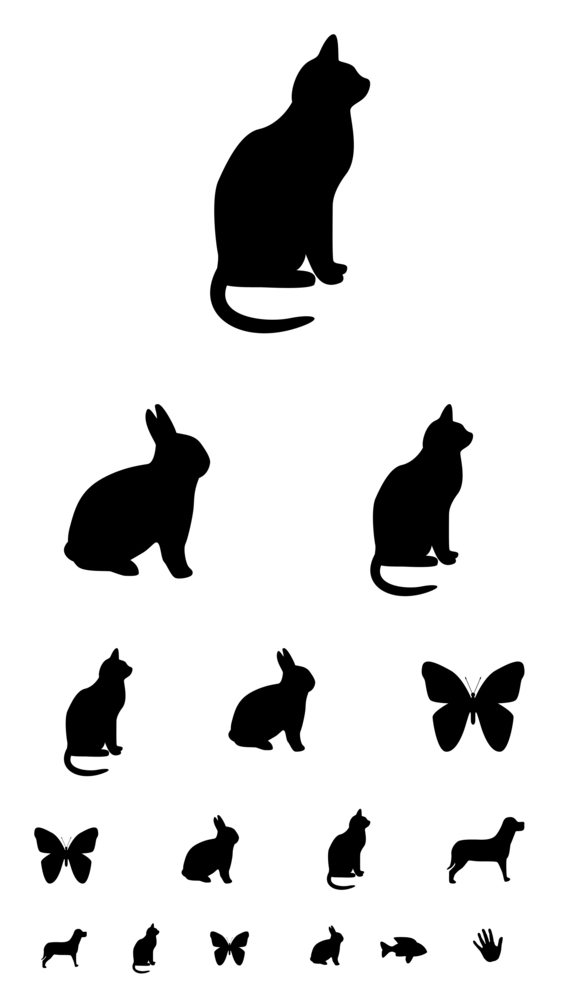
A child does not need to read for this test, as an optometrist will use a specific eye chart for children, often consisting of animal silhouettes.
How Do I Know If My Child Needs To See An Optometrist?
Young children do not always know that their eyesight is poor, they may think it’s normal that faces or words are blurred. This is why it’s important for parents and carers to be aware of the signs that indicate a child may need to see an optometrist and have their vision checked.
6 key indicators that your child needs a sight test:
Holding a book or tablet too close to the eyes when reading - Poor vision can become more obvious once a child learns to read or starts school. One of the signs of poor vision is a child holding a reading book very close to their eyes- this could be a sign of Myopia (nearsightedness) or holding the book at arm's length, Hyperopia (farsightedness), so it's worth getting their eyesight tested.
Sitting too close to the TV or computer screen - Often, the first time a parent notices a child might have a vision problem is when they notice their child likes to sit very close to the TV or computer. Children should not need to sit close to the TV or computer screen to see it clearly, so if your child is doing this regularly, it is a good indicator that they should see an optometrist for a sight test, as it may be a sign of short-sightedness.
One eye turning in or out - If you notice one eye consistently turning towards the nose or outwards, particularly after the age of three months, arrange an eye examination promptly. Early treatment gives the best chance of preventing a lazy eye (amblyopia)
Headaches and Squinting often - A child may complain of headaches - although headaches in children have many possible causes, frequent headaches associated with reading, schoolwork or screen use should be discussed with an optometrist. Excessive squinting is always worth getting checked out by an optometrist.
Rubbing their eyes often - A child may not know that their vision is not perfect, and can often try rubbing their eyes, hoping it will make them see clearly.
Children rubbing their eyes can be a sign that they are experiencing impaired vision or suffering from an allergy such as hay fever, and can lead to a higher risk of conjunctivitis. If you notice your child rubs their eyes frequently, take it as a sign that they should see an optometrist.
Finding some sports difficult - Poor hand-eye coordination is not always an eyesight problem, but if your child has difficulties with catching a ball, or judging distances, it may be a case that their vision is not as good as it should be. Having perfect, or corrected, vision can make the difference between avoiding and enjoying sport.
Most high street opticians have great ranges of glasses for children, and did you know children as young as 8 years old can successfully wear contact lenses, although it is worth noting that parental consent is needed for children under the age of 16.
Remember, children don't need to be able to read to have a sight test. If you have any concerns about your child's vision at any age, don't wait until they can tell you something is wrong. Early assessment and treatment can make a lasting difference to their visual development, confidence and success at school. A child under the age of 16 (and up to the age of 19 if in full-time education) is entitled to a free sight test covered by the NHS. They are also eligible for an NHS optical voucher to help towards the cost of glasses or contact lenses.