
A 50% growth!
The biggest glaucoma number this year was not a rise in the disease itself but more of a correction.
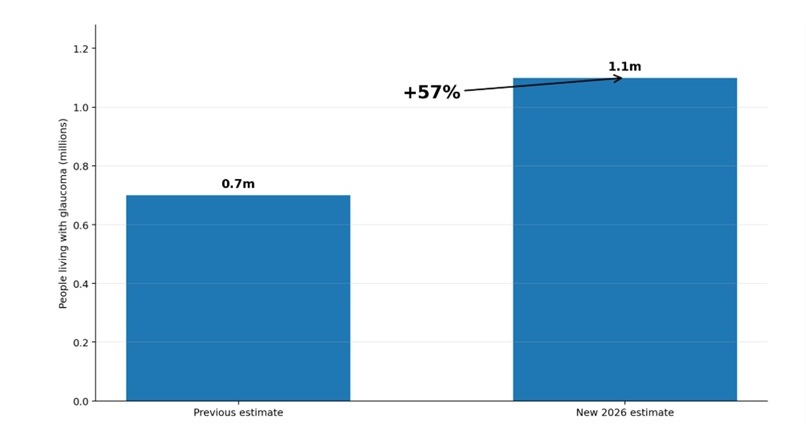
In January, researchers from UCL and Moorfields Eye Hospital published new prevalence estimates in the British Journal of Ophthalmology (which was commissioned by Glaucoma UK). The new figure for the UK is about 1.1 million people living with glaucoma now. The previous number quoted for years was 700,000, a big underestimate of how many cases go undiagnosed and one that didn't reflect current population sizes.
Even though it is a massive 50% revision upwards it's not a surge but more of a measurement fix.
UK glaucoma statistics for 2026
• 1.1 million people in the UK are estimated to have glaucoma, about 3% of the population aged over 40.
• Prevalence is roughly 11% in people aged over 85 and about 4% among people of African descent.
• More than 500,000 cases are thought to be undiagnosed. The old rule of thumb that half of all glaucoma goes undetected still holds.
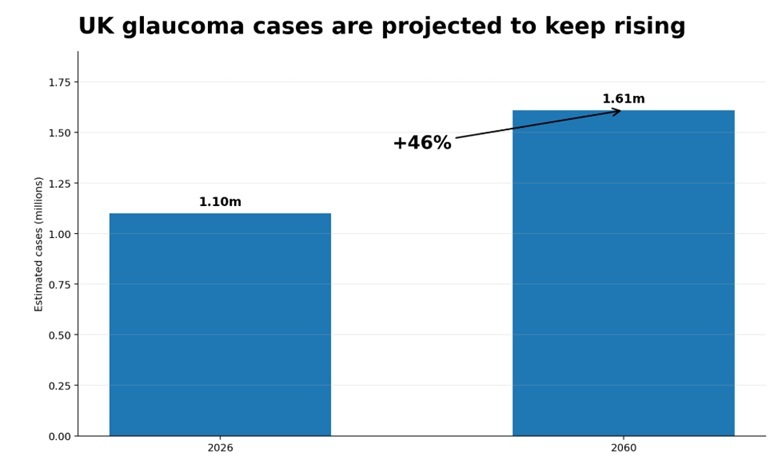
• Cases are projected to reach 1.61 million by 2060, a potential 60% increase,while the over 40 population grows by only 28%.
• Non European groups make up 6% of the UK population aged 65 and over but an estimated 8% of current cases.
Professor Paul Foster has pointed out that more than 40% of UK glaucoma patients have vision loss that could have been prevented with an earlier diagnosis and treatment. That is the more useful statistic. The 1.1 million tells you how big the problem is.
Global glaucoma statistics
Most publications still cite Tham et al. from 2014 and the 76 million people affected in 2020 rising to 111.8 million by 2040 with prevalence of 3.54% in the 40 to 80 age group. That paper drew on studies published up to 2013. It was due an update and it has finally come.
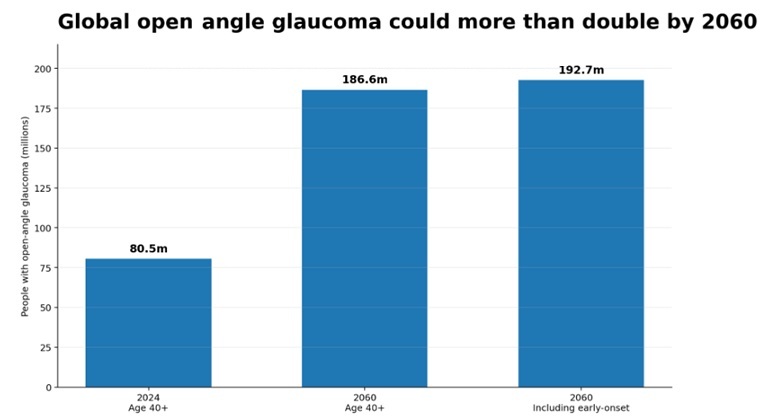
Wang and colleagues published new projections in the American Journal of Ophthalmology in it's March 2026 issue. Their estimate for open angle glaucoma in people aged 40 and over is 80.5 million in 2024 rising to 186.6 million by 2060.
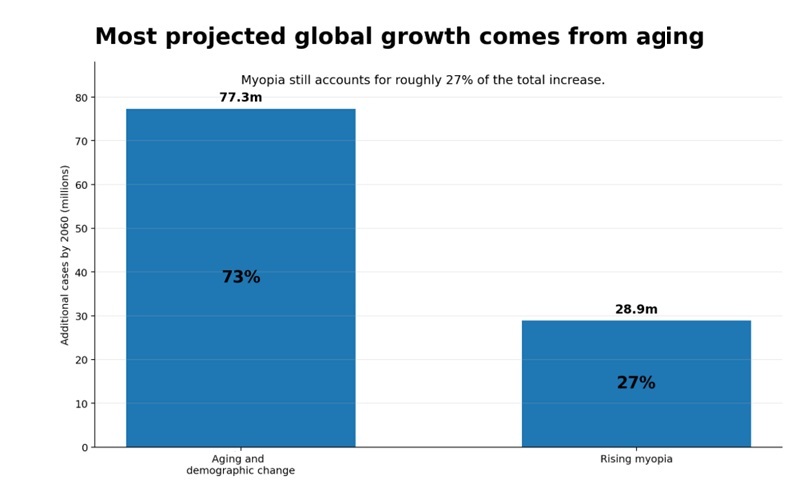
Aging and demographic change account for 77.3 million of the growth. The remaining 28.9 million or 27.2% of the total increase is attributed to rising myopia. Add 6.1 million early onset cases among 20 to 39 year olds with high myopia and the 2060 total reaches 192.7 million. East Asia sees the sharpest relative rise with prevalence up 50.5% from 2.3% to 3.4%.
Glaucoma has always been seen as a disease of aging. This is the first projection to price in myopia as a second point shifting part of the burden onto people under 40.
Sight loss is a separate number
Prevalence and blindness get conflated constantly in glaucoma content and they are not the same question.
A 2020 meta analysis published in Eye estimated that glaucoma caused blindness in 3.61 million people, 8.4% of the 43.3 million blind people worldwide, plus moderate to severe visual impairment in another 4.14 million. That puts it second to cataract for blindness overall and first for irreversible blindness, because cataract can be treated.
In Europe, the IAPB Vision Atlas puts prevalence at 12.3 million, more than half of it undiagnosed, rising above 13.5 million by 2050.
United States figures
The CDC's Vision and Eye Health Surveillance System, published in JAMA Ophthalmology estimated 4.22 million US adults with glaucoma in 2022. That is 1.62% of adults and 2.56% of those aged 40 and over. Roughly 1.49 million had vision affecting glaucoma, which is about 35% of all cases. Black adults are around three times as likely as white adults to have vision affecting glaucoma. Prevalence ranged around 1.95% in Mississippi down to 1.11% in Utah.
The CDC's own glaucoma programme states that more than 3 million Americans affected rising to 6.3 million by 2050 costing $2.86 billion a year in direct costs and lost productivity. Two different numbers on one organisation's website.
3% of UK over 40s against 2.56% of US over 40s does not mean Britain has more glaucoma. The studies use different case definitions different reference years, different diagnostic thresholds and different modelling. The 80.5 million global figure covers open angle glaucoma only while Tham's 76 million included angle-closure.
The real bottleneck is detection and follow ups
Treatment is not the weak link. NICE recommends selective laser trabeculoplasty as a first line option for chronic open-angle glaucoma and ocular hypertension, alongside eye drops. Finding patients and then keeping track of them is the hard part.
In England, roughly one in 12 patients waiting for a first specialist appointment is in ophthalmology according to a report published this July by Newmedica with analysis from CEPA. More than 11.4 million people are waiting for follow-up care across all specialities, and there is no requirement to publish follow-up waiting times at all. Waiting list pressure rose by between 10% and 30% across many integrated care boards during 2025.
Glaucoma is managed through follow up appointments. If follow up delay is the one thing nobody measures, then the 500,000 undiagnosed cases are only half the story.
The practical bit
Sight tests from midlife onwards are the answer and they are free for a lot of people who do not realise it. In England, Wales and Northern Ireland an NHS sight test costs nothing if you are 60 or over, have been diagnosed with glaucoma or diabetes, have been told by an ophthalmologist that you are at risk or are 40 or over with a parent, sibling or child who has glaucoma. In Scotland, everyone qualifies.
Sources
https://www.ucl.ac.uk/news/2026/jan/over-1-million-estimated-have-glaucoma-uk
https://medicalxpress.com/news/2026-01-uk-glaucoma-cases-higher-million.html
https://pubmed.ncbi.nlm.nih.gov/41421762/
https://www.reviewofoptometry.com/article/glaucomarelated-blindness-decreased-between-2000-and-2020
https://visionatlas.iapb.org/news/glaucoma-burden-in-europe-projected-to-exceed-13-million-by-2050/
https://www.aaojournal.org/article/S0161-6420(25)00344-6/fulltext
https://www.cdc.gov/vision-health-data/prevalence-estimates/prevalence-estimates-glaucoma.html
https://wchh.onlinelibrary.wiley.com/do/10.1002/psb.0010055
https://www.aop.org.uk/ot/features/2026/07/20/fixing-nhs-ophthalmology-followup-wait-lists-together